




Written by
Lance Owide
Ecommerce for Manufacturers
Get The Print Version
Tired of scrolling? Download a PDF version for easier offline reading and sharing with coworkers.
A link to download the PDF will arrive in your inbox shortly.
Key highlights:
B2B buyers have shifted online. Manufacturers must meet rising customer expectations with seamless digital purchasing experiences.
Ecommerce unlocks new growth. Drive online sales, support B2B and direct-to-consumer models, and turn your full product catalog into a scalable revenue engine.
Complexity requires the right platform. From custom pricing and ERP integrations to bulk orders and multi-region operations, manufacturers need flexible, purpose-built technology.
Digital transformation improves efficiency. Automation, real time data, and connected order management streamline operations and increase customer satisfaction.
Future-ready manufacturers win. Investing in AI, automation, and modern ecommerce infrastructure positions your business for long-term success.
Manufacturers are rethinking how they sell.
Procurement teams research products online before speaking to sales. Buyers expect instant access to specs, transparent pricing, and real time inventory. At the same time, competitors invest in digital channels that never close.
Traditional sales models alone cannot keep up.
Ecommerce gives manufacturers more control over the buying journey and a direct connection to customers. It unlocks new revenue across B2B and direct-to-consumer models while turning a full product catalog into a scalable growth engine.
But success requires the right foundation.
Manufacturers manage complex pricing, negotiated contracts, bulk orders, ERP integrations, and multi-region operations. Your B2B ecommerce platform must support that complexity without slowing you down.
BigCommerce helps manufacturers streamline operations, power sophisticated buying experiences, and scale confidently, without extra fees cutting into margins.
Ecommerce is not just a storefront. It’s a smarter way to grow.
The shift for B2B manufacturer buyers
The global pandemic reshaped manufacturing.
Supply chain disruptions and market uncertainty pushed manufacturers to operate leaner and move faster. At the same time, digital commerce accelerated across the industry.
The customers did not change. Their expectations did.
Today’s B2B buyer researches products online, compares options digitally, and often completes purchases through ecommerce channels. The journey no longer relies solely on sales reps. It blends in person relationships with self service online ordering.
Manufacturers must meet buyers where they are.
A strong digital presence and a connected ecommerce strategy help manufacturers deliver the seamless omnichannel experience buyers expect while protecting market share and long term loyalty.\
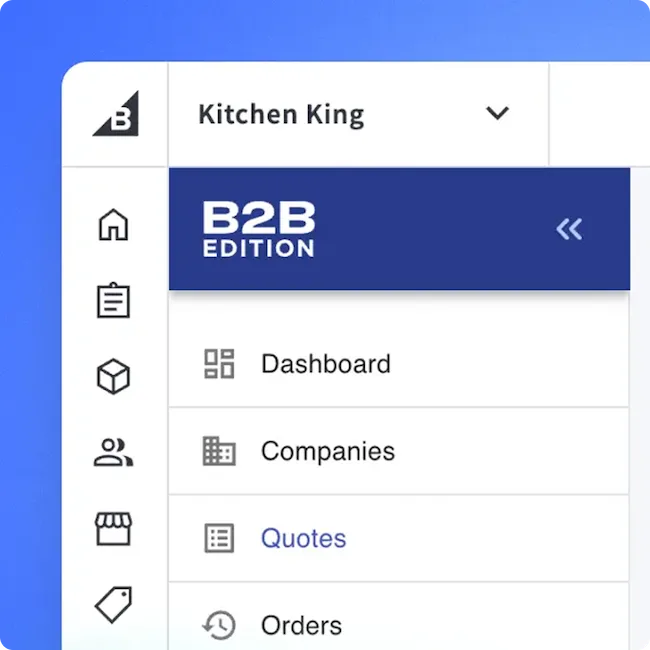
We're serious about B2B.
BigCommerce B2B Edition gives you account management and quoting tools to help your sales team get more orders.
Benefits of manufacturers having an ecommerce website
Given the acceleration of B2B ecommerce, launching an ecommerce business makes sense profit-wise. However, there are several more benefits beyond monetary gains:
Direct access to customers.
The perks of the direct-to-consumer (DTC) business model are well known among B2C brands, but there are also several benefits for B2B manufacturers that sell through their ecommerce website over distributors:
Preserving higher profit margins.
Strengthening customer relationships and capturing data about their needs and preferences.
Exerting greater control over brand representation.
Ensuring optimal pricing and discount strategies.
Collecting customer data for personalization.
Increasing customer loyalty through on-brand retention campaigns.
Opportunities to innovate.
By knowing how consumers shop and what they value in their suppliers, you can develop unique value propositions. For example, feedback from equipment end users can tell you which add-ons or modifications to prioritize.
Procurement data can suggest when certain parts are due for replacement so that you could pitch an early delivery to the buyer. Feedback from sales reps and support agents can suggest how you can improve after-sales services, such as introducing better delivery schedules, improving warranty, or expanding the scope of installation/training services.
Scalability.
Ecommerce greatly increases your bandwidth for processing orders without the need to attract more distributors or hire extra sales reps. Items that don't need any customization can be instantly sold to the buyers without in-person contact.
What's more, you can seamlessly tap into new markets and attract new customers.
Search engines can play a huge role in how new customers will find your website. Thus, enhancing your search engine optimization (SEO) and having a strong online presence is crucial to attracting new customers and establishing a competitive advantage.
Improved efficiency.
Because orders are processed digitally, buying efficiency and effectiveness can be improved for manufacturers and other types of B2B sellers.
By using an ecommerce platform, you’ll be able to automate time-consuming manual processes, such as checkout, billing, and inventory management.
As a result, you can devote time and resources to other core business activities, such as marketing and customer support.
Sell your complete product catalog.
As a manufacturing company, you likely have a large number of products, including personalized products, that vary in price depending on the customer and segment. Plus, you’ll want to offer personalized product suggestions to prospective customers to help increase conversions.
With an ecommerce platform, you can cover both of these bases, syncing your entire catalog to your website and configuring prices as needed.
BigCommerce, for example, is built for big catalogs. In fact, merchants can add up to 600 SKUs per product. Plus, our platform makes it easy for hybrid businesses with both B2C and B2B customers to offer different price lists or catalogs to customer groups.
Brand awareness.
Beyond digital marketing and social media, manufacturers can SEO optimize their ecommerce website to capture both product and branded search traffic, helping more buyers discover their full catalog. Many ecommerce platforms include built-in SEO capabilities, and BigCommerce delivers optimized and unique URLs, microdata, a content delivery network, plus 301 redirects and URL rewrites right out of the box.
Get a clear view of your B2B digital maturity.
Learn key areas for improvement and actionable insights to help your business grow faster and smarter.
How to effectively use ecommerce for manufacturers
B2B customers have an array of sales channels to choose from — distributors, channel partners, online marketplaces, resellers. The main goal for a manufacturing business is to provide an easier purchasing experience for them via ecommerce.
Create an engaging website.
By revamping your digital presence and offering a B2C experience for your B2B buyers, you’ll be able to transform a non-transactional, static website into one that is transactional and interactive.
Try integrating elements such as videos, educational resources, self-service functionality, and specific pricing to help engage customers and keep them returning to your online store for more.
On top of that, it is vital to have a frictionless and secure checkout process in order to enhance the online ordering experience.
Provide a personalized catalog.
Today, B2B retailers can harness ecommerce’s ability to customize experiences and give shoppers what they want in the shortest amount of time.
For example, ecommerce sites can provide product recommendations based on customer data — such as geo-location or demographic — which can lead to a significant increase in conversion rates and a decrease in cart abandonment. Try making recommendations for complementary products based on what product page the customer is browsing or their order history.
Or, consider implementing a quick reorder option. BigCommerce B2B Edition, for example, offers a Quick Order Pad that gives customers an easy way to quickly reorder products.
Real-time product information.
One of the greatest conveniences of shopping on B2C sites is the ability to view detailed product information and real-time inventory updates.
Take Amazon, for example. Anyone can search for an item and easily access its dimensions, available colors, materials, and pricing, as well as whether or not the product is in stock.
As real-time product information becomes the norm within the B2C space, it’ll be no surprise if B2B customers expect the same functionality on B2B ecommerce sites, too.
Luckily, some ecommerce platforms offer PIM and ERP software that can aid merchants in managing real-time product information and inventory updates. BigCommerce, for instance, offers ERP integrations to track sales orders, fulfillment, inventory management, warehouse management, replenishment, and more.
Sell on marketplaces.
Digital purchasing is accelerating, with 62% of industrial buyers reporting they purchase products online. That shift extends beyond distributor websites to major online retailers and marketplaces.
Connecting your ecommerce platform to leading marketplaces like Amazon and Google helps manufacturers meet buyers where they already search and compare products. BigCommerce integrates with top marketplaces and social channels, including Google Shopping, Amazon, Facebook, eBay, and Instagram, making it easier to expand reach, capture new demand, and drive incremental sales without duplicating backend operations.
Integrate customer reviews.
No matter the type of business, one of the most powerful sales tools is a review. Highlighting that customer experience, especially a positive one, can help influence someone else’s purchasing decision.
If these are located on high-traffic pages such as product pages, be sure to monitor them closely.
Why BigCommerce is a top option for manufacturers
Manufacturers need more than a basic ecommerce platform. They need technology that supports complex pricing, large catalogs, ERP integrations, and multiple growth models across B2B and direct-to-consumer.
BigCommerce delivers.
In the 2025 Paradigm B2B Combine, BigCommerce outperformed all competitors in the mid-market report and earned a full complement of medals in the enterprise edition, reinforcing its strength across both growing and large-scale manufacturers.
BigCommerce B2B Edition users also achieve a 391% three-year return on investment, demonstrating measurable impact beyond launch.
As a modern ecommerce platform built for mid-market and enterprise businesses, BigCommerce combines enterprise-grade functionality with flexibility. Manufacturers can integrate seamlessly with existing ERP and CRM systems, support customer-specific pricing and quoting workflows, and scale across regions and storefronts without payment fees when processing orders through 20+ embedded payment providers.
For manufacturers looking to modernize operations, unify sales channels, and future-proof their digital strategy, BigCommerce provides the foundation to grow with confidence.
Future of ecommerce for manufacturers
Ecommerce is no longer just about putting products online.
It is becoming the operational backbone of modern manufacturing businesses.
As digital purchasing continues to grow, manufacturers are investing in smarter systems that improve efficiency and unlock new revenue. Automation reduces manual order processing. Real time ERP integrations increase accuracy. AI powered search and merchandising help buyers find products faster across large catalogs.
At the same time, flexible commerce architectures give manufacturers more control over how and where they sell, whether through customer portals, marketplaces, or direct channels.
The goal is not just digital presence.
It is long-term scalability.
Manufacturers that build a connected, adaptable commerce foundation today will be better equipped to launch new products, expand into new markets, and meet evolving customer expectations tomorrow.
The final word
Ecommerce is redefining how manufacturers grow.
Buyers expect speed, transparency, and flexibility. Competitors are investing in digital channels. And emerging technologies like AI and automation are raising the bar even higher.
Manufacturers that treat ecommerce as a long-term growth strategy, not just an online ordering tool, will be best positioned to compete and scale.
If you are ready to modernize your digital commerce strategy, streamline operations, and unlock new revenue opportunities, connect with a BigCommerce expert today.
Contact our sales team to start building your next phase of growth.
FAQs about ecommerce for manufacturers
Ecommerce enables manufacturers to sell products online through a dedicated B2B ecommerce platform that connects directly to backend systems like an ERP system. Customers can browse complex products, view custom pricing, configure product configurations, and place orders through a secure online portal.
Modern B2B ecommerce solutions also integrate with order management and order processing systems, ensuring accurate inventory, pricing, and fulfillment. Instead of relying solely on traditional B2B sales teams, manufacturers use digital tools and APIs to streamline sales processes and support both self service and rep assisted transactions.
Manufacturers are expanding into ecommerce to increase online sales, meet rising customer expectations, and gain more control over the buyer journey. As the manufacturing industry becomes more competitive, businesses can no longer rely only on wholesalers and offline channels.
Ecommerce solutions allow manufacturers to reach customers directly in a business-to-business environment while improving customer satisfaction through faster ordering, better visibility into inventory, and personalized experiences. Digital channels also help manufacturers launch new products faster and scale revenue without proportionally increasing overhead.
Digital transformation in manufacturing ecommerce goes beyond launching a website. It involves integrating a B2B ecommerce platform with core systems like ERP, CRM, and product information management tools.
Manufacturers are investing in automation, APIs, and advanced order management capabilities to modernize operations. By connecting ecommerce with existing sales processes, companies reduce manual work, improve order processing accuracy, and deliver a stronger user experience. Many brands highlight these gains in case studies that showcase improvements in efficiency, revenue growth, and customer satisfaction.
Retail ecommerce typically focuses on individual consumers and simple transactions. Manufacturing ecommerce, by contrast, supports complex products, bulk ordering, product configurations, and custom pricing structures.
In a business-to-business setting, buyers often need account specific catalogs, negotiated pricing, and integration with procurement systems. A purpose built B2B ecommerce platform is designed to handle these requirements, ensuring the user experience reflects the realities of industrial purchasing rather than consumer shopping.
A flexible ecommerce strategy allows manufacturers to support traditional B2B sales, direct-to-consumer channels, and hybrid B2B2C models from a single platform.
With the right B2B ecommerce solutions, manufacturers can serve wholesalers, distributors, and end customers simultaneously. APIs make it possible to connect systems, sync pricing, and manage different catalogs across storefronts. This unified approach increases online sales opportunities while maintaining consistent order management and operational control.
Operational complexity is often the biggest barrier. Disconnected digital tools, outdated ERP systems, manual order processing, and siloed sales processes can slow down growth.
Manufacturers must ensure their ecommerce solutions integrate seamlessly with backend systems to avoid inventory inaccuracies, pricing errors, and fulfillment delays. Without strong order management and clear workflows, it becomes difficult to meet customer expectations and maintain high customer satisfaction.
The right B2B ecommerce platform addresses these challenges by centralising data, automating processes, and creating scalable infrastructure that supports long term growth in the manufacturing industry.
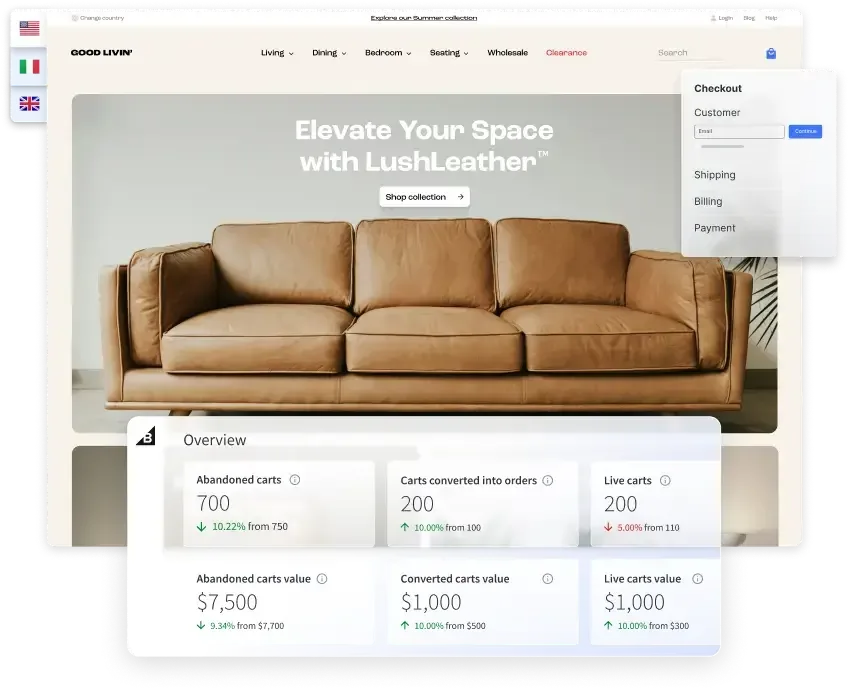
⏰ Isn't about time that you evaluated your ecommerce platform?
Request a demo to see how the BigCommerce platform is different.